If Dick Hallgren were alive today…what would be his message?

Meteorologists are hardly celebrities. They’re not visible on the world stage in the same way as entertainers or political figures or the wealthy. Fact is, their work is often most successful when their accomplishments are least noticeable: a forecast of adverse flight conditions enabling the FAA to redirect air traffic; a forecast of coming severe weather that prompts the farmer to harvest a crop a day earlier; a prediction that a hurricane will intensify overnight that puts coastal emergency services on heightened alert; and so on.

For that reason, attempting to identify and rank meteorologists whose immediate past work has most influenced the weather services of today would be a challenge, even for those in the field.

But the name Richard Hallgren should be on a lot of top-ten lists. Repeating a bit of background: Dick’s career began in the 1950’s and spanned more than a half-century, including stints with the Air Force, IBM, NOAA, and the American Meteorological Society, and a continuing role at the World Meteorological Organization; he was actively mentoring service meteorologists and researchers worldwide through regular phone calls until a few weeks before his passing in late 2023. During his nine-year tenure as Director of the National Weather Service (1979-1988) he formulated and led substantial Agency modernization. He reinvented NWS outreach to and partnership with what is today’s vibrant meteorological private-sector. He increased America’s contributions and stature in provision and coordination of weather services globally. His work led to greater safety for all Americans – from farmers to the flying public to those facing immediate threats from floods and drought, winter storms, hurricanes, tornadoes, and more.

Our world today is weathering a season of another kind of tempest and hazard. Weather extremes are hitting once-resilient populations rendered vulnerable by recent years of pandemic, disease, poverty, war, terrorism, political turmoil, and civic polarization. Too many of these wounds and their accompanying weather vulnerabilities are self-inflicted. Armed conflicts rage across Europe, the Middle East, Asia, and Africa. Much of the fighting and global unrest is driven by a handful of leaders (not the majority) who care more for a peculiar, unfathomable idea of personal gain than the true needs of their people.

It’s common in time like this when recalling great figures from the past (or our parents or loved ones, for that matter) to think or say something along the lines of “it’s a good thing he or she didn’t live to see this day.”

That’s not the case with Dick. He was made of stern stuff; he wouldn’t be happy with present events or trends, but he wouldn’t cringe. He’d have wanted to be here, and in the action. He’d be vigorously articulating and promoting a raft of good ideas to make for a more peaceful, fair, prosperous, and safer world.

He’d be thinking broadly, but he’d also have strong views on matters closer to home: in particular, the forced retirements, indiscriminant firings, and hollowed-out staff levels of the National Weather Service today, and the implications for the American public.

How would he see things? What would be his message today? Well, here’s a guess – with a little presumption (but not much, because he was so clear and outspoken on a range of similar challenges throughout his life and career).

He would begin with thanks. He would offer praise and encouragement to every NWS employee, from Ken Graham and the leadership at the top to the shift forecasters and other staff at the local forecast offices. This praise would cover present employees but also those of the recent past. It would include those retired, those let go, not just those remaining. He’d salute their acumen and their energy and commitment to public service. He’d commend the service improvements they’d accomplished in recent years and the truly heroic effort they’re making in the face of budget cuts, organizational downsizing, etc. to maintain those high standards.

He would stress mission. He’d emphasize now, as he did in life, that the mission of NOAA and NWS is not simply to make forecasts. The mission is to protect life and public safety in the face of hazardous weather. And in the next breath he’d remind us all that Americans face the world’s greatest weather hazards: the same number of winter storms as Canada and Russia. The same number of hurricanes as tropical Pacific and Atlantic nations. Much more dangerous summer convective weather – including a virtual monopoly on the world’s tornadoes. He’d explain that it would always be tempting to save a bit here and there on the costs of any level of mere forecasting skill, but it would never be acceptable for any responsible administration to make budget-, personnel-, and facility cuts that would put American lives, incomes and property at risk.

He would put people first. As clear from the mission, that would start with the interests and needs of the American public in harm’s way. But it would extend to all people worldwide. Dick would note that weather knows no boundaries; therefore, to know what the weather will do next requires continuous observations and inputs from all corners of the globe. Because the work and costs are distributed worldwide, the benefits should be shared universally as well. Because the important weather impacts are human, he’d know that artificial intelligence and other technologies notwithstanding, it will always be vital to keep human beings in the weather services loop. And because that very human work matters, nations should do their best to maintain stable and functional meteorological work environments.

Accordingly, he would see weather warnings in the face of hazard as a public good. He would note that rich or poor, all live on a planet that does much of its business through extremes of heat and cold, flood and drought, storms and calm (the latter equally hazardous because of its implications for air quality). He would remind all parties that access to life-saving weather information is a basic human right.

He would stress public-private partnership. Just over one percent of American workers are civilian federal employees (a similar fraction are in the uniformed services). This figure is dwarfed by public-sector employees at the state and local level – perhaps 12% of the total workforce. The figures are similar to the worldwide demographics. The vast majority of people live and work in the private sector. That’s where particular weather-related vulnerabilities and opportunities lie. Partnerships are necessary to get weather information to the global public. But that dissemination is not itself the end. That accomplished, other partnerships are vital to then realize weather’s economic and recreational opportunities and to protect against weather risks.  And partnership is not accomplished by savaging or doing away with either the public- or private partners.

He would call for continuous innovation. That would extend beyond merely “doing things right,” to also “doing the right things.” He was always aware that weather is natural, but weather vulnerabilities are a human construct and therefore are constantly changing in response to social change and technological advance. He was always careful to describe the NWS modernization carried out during his tenure as “the Tenth Modernization.” Because he saw the vital importance of people (there’s that idea again!) he used the full title “NWS Modernization and Associated Restructuring,” before launching into a short speech about enabling and empowering the NWS workforce in the execution of its mission. The Modernization reduced the number of offices from some 300 to about 120, while at the same time better equipping the staff, and keeping them close to the local publics and partners they served.

He would stand for identifying and exploring options. Dick was not a member of the ready-fire-aim school. He would decry any break-things-and-see-what-happens approaches to weather services. He’d want to see options before settling on any particular plan or course of action. And he’d want to see multiple options, not just a coin toss to choose among two. He frequently said that the worst human mistake was the invention of coins that only had two sides.

He would be unable to resist telling us “I told you so.” An example, especially poignant in light of recent U.S. events: For decades, Dick railed against each of a multi-year series of small agency steps and actions that have separated NOAA’s weather and climate services, and using those two labels. He understood how different natural processes come into play at longer time scales. But he argued that nature made no sharp distinction or strict boundary line separating “weather” vs. “climate.” Instead, the atmosphere was resolutely variable from minute-to-minute to days to seasons to centuries, and across local and regional and global geographies. He thought we should respect that unity in the corresponding services and their delivery. He also was mildly offended whenever (and this was on a daily basis) different governmental forecasts and private-sector forecasts contradicted each other with regard to forecasts of temperatures, precipitation, and timing and location of events, outside their claimed error bars. He thought this led to public skepticism. He wanted more care in forecast uncertainties.

And being Dick, he’d look at this LOTRW blogpost and spend a half hour listing its omissions, misrepresentations, and other shortcomings, relieving the pain only slightly with an occasional grin. Where’s something on connection of research to services (and the need to fence and protect their budgets)? What about the dangers of content-free leadership? What about…? Such debriefs would usually be terminated only by a smartphone interruption from Australia or the like.

We miss you, Dick.
Posted in Uncategorized | 8 Comments

The National Weather Service, NOAA, and their civil servants: Unbroken.

In 2010, Laura Hillenbrand[1] published her biography of Louis Zamperini, entitled Unbroken: A World War II Story of Survival, Resilience, and Redemption. According to Wikipedia, the book spent more than four years on The New York Times best seller list, including 14 weeks at number one, making it the 5th longest-running nonfiction best seller of all time. Unbroken was subsequently made into a 2014 war-drama movie hit, produced and directed by Angelina Jolie.

A recap, ICYMI: Louis Zamperini had a rocky, largely delinquent youth, but in high school became an accomplished runner, competing in the 1936 Berlin Olympics in the 5000 meters (!). He then ran track at USC, graduating in 1940. World War II interrupted his athletic aspirations. He served in the Army Air Force in the Pacific theater, miraculously surviving several harrowing combat missions, before his B-24 aircraft suffered mechanical failure while conducting a supposedly routine search. Of the eleven crew members, only he and two others survived the crash into open water, 800 miles from Hawaii. They drifted by raft 2000 miles westward for 47 days (one of the three died during this phase of the ordeal) before making landfall on the Marshall Islands, where they were immediately captured by Japanese. Zamperini spent the next two years as a POW, surviving hard labor and torture. His plight was exacerbated by one of his Japanese captors, one Mutshiro Watanabe[2], who held him in a high degree of personal animus, relentlessly tormenting him both physically and mentally. Zamperini had been listed as dead throughout this period and was not released and reunited with his family until war’s end.

The movie, like the book, was a big hit. Zamperini’s grit and courage in the face of a series of adversities of such unimaginable nature and duration is hard to witness even secondhand. At the same time it is inspiring. If you’re an LOTRW reader, and of a certain age, you may well have seen the movie, read the book, or both.

So why bring it up now?

Because, if you’re an NWS or NOAA civil servant – whether you’ve been (prematurely and precipitously) retired; or abruptly terminated; or are still employed, trying to do your job as well as take on some of the work of those no longer at your side – your experiences have much in common with Louis Zamperini.  

You might say that the moment-by-moment threat to life is not similar, and you’d be right. But you endure substantial challenges just the same. For those prematurely retired or fired – there’s the loss of income and its accompanying series of individual and family hardships and emergencies. There’s the additional stress of being all too close to the trials and suffering of onetime-co-workers and being unable to help. But there’s also the loss of a long-held purpose and vision – your dedication to a career of public service, saving lives and property in the face of natural hazards. If you are one of those still in the NWS/NOAA workplace, it’s a daily battle to keep that vision in mind amidst the pressure of doing-less-with-less; running the next forecast, putting out the next outlook in the uncertainty of wondering whether it’ll be your last, or whether it will adequately protect lives and property. It’s being part of something you never thought you would see – an agency struggling to keep the lights on the face of 24/7 weather. All this is worsened, for all three groups, by the isolation and the lack of any script – not knowing how or when or even if the nightmare will end. And stress and trauma extends across the whole of the federal workforce.

You are indeed sharing some of the wartime experience of Louis Zamperini. But you’re not merely imitating him. You’re providing your own unique story of heroism, of bravery (not a lack of fear, but the mastery of fear), that will be captured by another generation of journalists and biographers.

You probably don’t see yourself as heroic. But keep this in mind: He didn’t either. He was just a survivor – for the moment. He was in the business of getting through one more hour of one more day. And he didn’t know when there would be an end, whether in one day or a thousand, and the end-scenarios most likely for him were not happy ones. He saw a hostile environment – the suffering wasn’t the result of a freak accident, a twist of fate. It was suffering deliberately caused by others.

He didn’t see himself as a hero. But he was.

And so are you. Yours, like his, is a Story of Survival and Resilience.

As for Redemption, that too will come, just as it did for Zamperini – and for Hillenbrand herself. Here’s the backstory.

Zamperini, the sequel. According to Wikipedia, Louis Zamperini may have been “unbroken” by his wartime experience, but he suffered severe PTSD (like today’s federal workforce). After the war, he would frequently dream of strangling his captors. He buried himself in alcohol, and in one episode unintentionally strangled his wife when she was pregnant with their child. Then one day she convinced him to go to a Billy Graham Crusade. There he remembered the promises he’d made to God in his wartime prayers, and he followed through, embarking on a changed life. Billy Graham subsequently helped him become an evangelist. He spent much of the rest of his days working with kids at risk in Los Angeles. Perhaps unsurprisingly, Zamperini focused much of his message on forgiveness. Over the years, as opportunities came his way, he met with several of his Japanese guards from POW days; some subsequently became Christians themselves. Zamperini even reached out to Watanabe, but never heard back.

If Zamperini was able to find it in his heart to forgive his captors, perhaps at some future point in your life there will be that same opportunity for you to forgive those responsible for all you’re going through now.

Laura Hillenbrand’s story. While a student at Kenyon College, Hillenbrand fell ill with myalgic encephalomyelitis, better known as chronic fatigue syndrome (ME/CFS), a disabling chronic illness.  Symptoms include but are not limited to vertigo, faintness and pain, as well as a deep fatigue unrelieved by rest. Symptoms worsen with exertion; subsequent “crashes” can endure for months. People with ME/CFS sleep issues and problems with memory or concentration. The hallmark symptom is post-exertional malaise, a worsening of the illness which can start immediately or hours to days after even minor physical or mental activity. This “crash” can last from hours or days to several months. Forced to drop out of college, Hillenbrand became a journalist and writer.

Imagine what effort it took in the face of an illness of that nature to write non-fiction – let alone truly powerful non-fiction. But Hillenbrand’s ordeals yielded an unexpected payoff. Zamperini had read an essay she’d written about her experiences. He figured she could be trusted to grasp what he’d been through. He opened up to her over the course of many phone interviews in the writing of her book, inspiring her in the process.

So, just a thought – in the midst of these present storms in your life, perhaps you’ll be able to carve out a few hours to stream that Unbroken video, or read or reread Hillenbrand’s excellent book. Maybe the exercise will get you in touch with your own heroism. Though different, your bravery is no less real than theirs.

A forecast: your redemption will be just as real as well.


[1] already well known as the author of the Seabiscuit: an American Legend (1999)

[2] After the war, Watanabe would go into hiding for years to avoid punishment for his war crimes, until the charges were dropped in 1952.

Posted in Uncategorized | Leave a comment

Former NWS Directors speak out.

This past week, the five living former directors of the National Weather Service issued an open letter to the American people. Their letter makes a powerful statement on an unfolding national risk, and a moving tribute to unsung NWS employees. With permission, the letter is reprinted here, verbatim:

An Open Letter to the American People

From All Former National Weather Service Directors

The proposed budget for fiscal year 2026, just released by the White House, cuts the National Oceanic and Atmospheric Administration (NOAA) by more than 25%. While details aren’t yet available, if earlier indications hold true this budget would essentially eliminate NOAA’s research functions for weather, slash funding for next generation satellite procurement, and severely limit ocean data observations.

Even if the National Weather Service remains level funded, given the interconnectedness of all of the parts of NOAA, there will be impacts to weather forecasting as well. We cannot let this happen. 

NOAA’s satellites provide vital information about the formation and pathways of storms. NOAA research on severe storms has paved the way for tools we now use every day, such as Doppler radar and storm modeling advancements. NOAA Corps pilots fly into hurricanes to bring us real-time information on these increasingly severe storms. And data from ocean buoys add breadth and depth to our understanding of the interaction between the atmosphere and the sea.

These proposed cuts come just days after approximately 300 National Weather Service (NWS) employees left the public service to which they had devoted their lives and careers. That’s on top of the approximately 250 NWS employees who were fired as a result of their probationary status in new–often higher-level positions–or took the initial buyout offered by the Trump Administration in early February. That leaves the nation’s official weather forecasting entity at a significant deficit–down more than 10% of its staffing– just as we head into the busiest time for severe storm predictions like tornadoes and hurricanes.

NWS staff will have an impossible task to continue its current level of services.  Some forecast offices will be so short-staffed that they may be forced to go to part time services. Not only are there fewer forecasters, there are also fewer electronic technicians, who are responsible for maintaining the critical NEXRAD radars. Our worst nightmare is that weather forecast offices will be so understaffed that there will be needless loss of life. We know that’s a nightmare shared by those on the forecasting front lines—and by the people who depend on their efforts.

For example, airplanes can’t fly without weather observations and forecasts; ships crossing the oceans rely on storm forecasts to avoid the high seas; farmers rely on seasonal forecasts to plant and harvest their crops which feed us. Additionally, dam and reservoir operators rely on rainfall and snowfall forecasts to manage the water supply; fishermen in the $320 billion commercial fisheries sector rely on forecasts to stay safe as do tourism and recreational boating communities. Perhaps most importantly, NWS issues all of the tornado warnings, hurricane warnings, flood warnings, extreme wildfire conditions, and other information during extreme weather events. The dedicated staff at weather forecast offices around the country work 24/7/365 to make sure you get that information.

A word about these public servants. They aren’t nameless, faceless bureaucrats. They are your neighbors; your friends; the people who provide lifesaving information when you need it. They live and work in every community in the country. Their dedication to public service – and public safety – is unparalleled. They will often sleep in weather forecast offices to make sure poor weather conditions don’t stop them from being on time for their shifts to do their critical work. They stay at their stations during hurricanes, tornadoes and other severe storms, even when extreme weather affects their own families. They make sure the complicated technology, like the radars we all see on television or on our apps, stay up and operating. They are the everyday heroes that often go unsung.

The NWS heroes who remain know that lives and livelihoods literally depend on the accuracy of weather forecasts as well as the prompt dissemination of that information to the people who need it. As former directors of the National Weather Service, we know firsthand what it takes to make accurate forecasts happen and we stand united against the loss of staff  and resources at NWS and are deeply concerned about NOAA as a whole. Join us and raise your voice too.

Louis Uccellini, Ph.D., NWS Director  2013-2022

Jack Hayes, Ph.D., NWS Director 2007-2012

Brigadier General D.L. Johnson, USAF (Ret),NWS Director 2004-2007

Brigadier General John J. Kelly Jr., USAF (Ret), NWS Director 1998-2004

E.W. (Joe) Friday, Ph.D., Colonel USAF (Ret), NWS Director, 1988-1997

Amen. In any given year the United States endures as many severe winter storms as other polar nations; as many hurricanes as any tropical country; and a virtual lock on the world’s severe tornadic storms. The five men co-signing this letter have led four decades of U.S. improvement in weather forecasts and warnings. Together they have served our country throughout their entire careers – well over a man-century of service in total. They’ve combined here to make a sobering forecast of a different kind. In the plain, dispassionate language they are warning that the personnel reductions underway and the budget cuts contemplated will critically undermine NWS and NOAA services needed to keep America safe and economically productive going forward.

We owe these men, and every NWS and NOAA public servant, our gratitude. We ignore this warning at our cost.

Posted in Uncategorized | 2 Comments

Remedial reading – Laudate Deum

The previous LOTRW post, occasioned by the conjunction of Easter, Earth Week, and the passing of Pope Francis, took a brief retrospective look at his climate-change encyclical Laudato si,’ published in 2015.

As noted many times in this blog, I continue to marvel with a mix of lament and delighted wonder at the ability of eight billion people to accomplish so much, on matters both great and small, while my back is turned. Unsurprising that FOMO is a thing.

This week’s belated catch? Perhaps I’m the only one, but ICYMI, in 2023 Pope Francis issued what the Vatican called an apostolic exhortation (not an encyclical) entitled Laudate Deum – a follow-up to Laudato si’. A much shorter read, it revisits the same ground after the passage of eight years. Papal frustration with the slow pace of progress (and possibly with the lack of any evidence that his prior encyclical had worked significant change), though controlled and thoughtfully expressed, is evident throughout.

In Laudate Deum, the pope argues that the science, which he had considered established in the earlier document, is indisputable, and chastises deniers. He is vexed that the powerful continue to minimize the threat through marketing and misinformation. He continues to push back against the idea that technology and economic power together will be sufficient to stem the damage. He reiterates the moral nature of the challenge, pointing out that the impacts of the environmental degradation will primarily affect the already-poor-and-disenfranchised of the world and will persist for hundreds of years at a minimum, diminishing the prospects of generations yet unborn. He reemphasizes the need for concerted action, sustained by all nations, by international leaders and governments, and by each of us as individuals. But he sees mixed benefits at best from climate conferences. He notes the increasing urgency of the problem.

It’s natural to share the Pope Francis’ concerns (a sign of our mental and spiritual health, really). Here in the United States, the pace of progress is threatened by formal U.S. withdrawal from climate-change agreements, the reopening of federal lands to fossil-fuel extraction, the dismantling of NOAA and EPA now underway, the termination of climate-change related work in other federal agencies, other federal-level policy inconsistencies and more.

However: at the same time, American corporations, especially those competing in global commerce, have ignored such policy shifts in favor of competing for market share worldwide. Renewable energy costs are falling rapidly, slowing growth In world- and domestic appetite for fossil fuels. At the state- and local levels, climate-change abatement policies remain in force. Artificial intelligence, while increasing demand for electricity, points the way toward energy-saving across a range of economic activities. There are reasons for hope.

To repeat a forecast I’ve made before[1]: two-three hundred years from now, humanity will look back on this period in history. From that vantage our descendants will see the year 2000 (plus-or-minus) as a turning point. They’ll say that high-tech observing tools and computing technology produced a flowering of understanding about the Earth system, and that the information arrived just in time, because eight billion people had been inadvertently turning the planet into an ash can. They’ll envy us. They’ll say: It must have been exciting to live and work during that period of discovery and positive progress. At the same time, they ‘ll talk about their present circumstance (living in the year 2200 or thereabouts): It’s not like today. Today all we have is a polarized population and governmental dysfunction as we confront a raft of unsolvable problems. That’s a mere forecast, so of course it carries uncertainty.

But I can also provide a near-guarantee: like Pope Francis, never, during the rest of our lifetimes, will we feel anything but frustration with our slow pace of progress towards this desired end.

Unspeakable personal and institutional tragedies, compounded on one another. Pain and suffering beyond description. But sometimes this is how it feels on the ground when things are going well…


[1] Living on the Real World: How thinking and acting like meteorologists will help save the planet, William H. Hooke, American Meteorological Society 2014, Epilogue, pp 235-237.

Posted in Uncategorized | Leave a comment

Laudato si’ – redux.

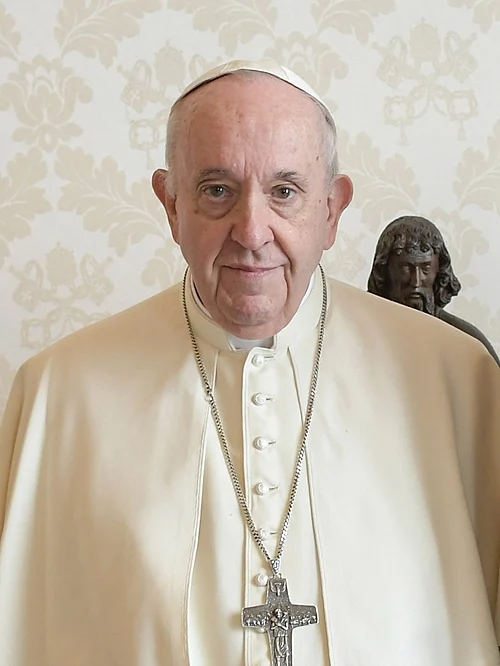
Pope Francis in 2021

Praise be to you!

Pope Francis died this morning. The news media are saturated with material and that material is being augmented and updated so rapidly that there is no need to offer a single link or two here. Much of the remembrance recalls his support of the marginalized, balanced by clashes with traditionalists, on a range of issues. He called for a more inclusive church. To this layman these attributes reflected the life and spirit of Jesus himself. Laudato si’ indeed.

Pope Francis also cared deeply about humanity’s relationship with the rest of God’s creation – especially the planet we live on. These views were most profoundly (and beautifully) expressed in his encyclical from 2015, Laudato si.’

It’s Easter Monday. Worldwide, thoughts of resurrection are in the air. It’s also Earth Week. So perhaps it’s appropriate for me to do something I don’t recall doing before – republish a previous LOTRW post in its entirety – this from June 20, 2015. Here goes, beginning with a quote from the pope’s namesake:

Praise be to you, my Lord, through our Sister, Mother Earth, who sustains and governs us, and who produces various fruit with coloured flowers and herbs   

– Saint Francis of Assisi

This sister now cries out to us because of the harm we have inflicted on her by our irresponsible use and abuse of the goods with which God has endowed her. We have come to see ourselves as her lords and masters, entitled to plunder her at will. The violence present in our hearts, wounded by sin, is also reflected in the symptoms of sickness evident in the soil, in the water, in the air and in all forms of life. This is why the earth herself, burdened and laid waste, is among the most abandoned and maltreated of our poor; she “groans in travail” (Rom 8:22). We have forgotten that we ourselves are dust of the earth (cf. Gen 2:7); our very bodies are made up of her elements, we breathe her air and we receive life and refreshment from her waters.

– Pope Francis

Praise be to God indeed! Thursday’s Papal encyclical on climate change breathes fresh air and spirit on a world and on a climate-change debate sorely in need of both. The depth and breadth of the discussion defy casual summary. To attempt to identify and lift nuggets from the larger whole or to pick-and-choose cafeteria-style among the arguments presented is misdirected if not futile, though we’ve seen numerous attempts in all the news and social media in the days since. What makes the nuggets truly golden are their settings – the precise wording and the carefully-woven context. That weaving is so deft and intricate that attempts to unravel particular bits from the fuller exposition leave something far inferior to the whole.

In other words, to feel the impact you and I had best read the encyclical in its entirety. That encouragement doesn’t even go far enough. To go further – not merely to feel its impact but to derive its benefit, to experience its healing – we need to meditate on it. And we’re not talking about meditating on it over a single weekend. The encyclical deserves regular revisits. Over months. Years. It’s going to stand the test of time.

Ten comments.

The encyclical is more about human nature than Earth’s nature. In fact it sees the two as inextricably intertwined, inseparable. Furthermore, it sees climate change not as a separate issue, or even as an issue in its own right. Instead it’s a symptom of human failings and shortcomings: greed, selfishness, hypocrisy, mendacity, etc. You could add shortsightedness except that at several points the text notes that we’re not merely oblivious to our wrongs and how they exacerbate the problem. Our actions are premeditated. We possess the needed self-awareness, and we see the bow wave of problems we’re creating for the poor and disenfranchised, for those less fortunate – and yet we proceed anyway.

It’s a Rorschach test. Scientists may be tempted to ignore the spiritual dimension, and focus on the realities of environmental degradation, loss of habitat and biodiversity. NGO’s focused on the plight of the poor, whether the poor nations or the poor within each nation, will exult over the papal support for their cause. Free-market voices of a certain stripe will decry papal attempts to “make all of us poor.” Political leaders of a certain persuasion will grouse about religious meddling in economic and social matters. Check the news summaries and the blogs. You’ll find everyone finding in the encyclical support for long-held positions and personally and institutionally-cherished preferences. (LOTRW is surely no exception; another reason you should read the encyclical from start to finish and draw your own conclusions.)

It’s reality-based. In support, here’s a snippet from section 201 of the encyclical: realities are greater than ideas (the original text includes a citation to an earlier Vatican work). But (especially scientist-friends) be warned; reality here is assumed to have physical, social, and spiritual dimensions. (An aside. Some scientists make it clear that non-experts should be cautious in arguing with scientists about climate change. Understood. But we scientists ought to be equally attentive to those who’ve studied spirituality in a disciplined way when they share what their studies on such matters have revealed. And if we’re reluctant to be blindly submissive on these latter subjects, then perhaps we ought to be more respectful to those who dare question our science.)

It sees these realities and our human challenges as fully integrated and inseparable. For example, the encyclical makes clear that our environmental problems stems from seeing nature and all its life and creatures as being mere objects as opposed to essential manifestations of the love and power and nature of God. It sees our indifference to the plight of lifeforms and landforms as intimately related to our disinterest in the suffering of others. It describes us as having allowed ourselves to drift into a state of slavery to technology as opposed to retaining mastery over it.

It is fully comfortable with both science and faith. At one and the same time the encyclical holds true to the idea of a created universe and embraces findings of science with respect to the size of the universe, the age of the earth, evolution of life, and the nature of reality at the quantum level. It is positive about the contributions of science and technology not just to material human welfare but beauty and the elevation of the human spirit. And interestingly, it doesn’t dither over these concerns; it simply blows right through them. Surely an encouragement to the rest of us to follow suit.

The moral message ought to arouse us more than the economic message. The encyclical makes much of our interest in individual material well-being as measured by conventional means. This has already come under attack from some quarters as “the pope urging us to all be poor.” But the deeper message of the encyclical is that when we enrich ourselves while turning a blind eye to the basic human needs of others – whether for food, or water, or shelter, or respect – we do great and indelible harm to our souls, and that this is the greater danger.

The encyclical is more celebratory than condemnatory. Throughout – in every section and every reflection, the encyclical reminds us that the Creation is good. It sees every aspect of physical reality both animate and inanimate as carrying a message about God’s love, power, interest in our well-being, and forgiving nature. It speaks to our access to joy and peace in light of this understanding. It speaks to the possibility of building a richer, more equitable, more sustainable, future.

It is a group construct. Surely Pope Francis called for it. Surely he made editorial comments as the work proceeded, and had a good deal to say about both its substance and tenor. But the encyclical clearly has as much in common with an IPCC report as it does with the prayerful reflection of a saintly, devout individual. There are frequent, quoted references to thoughts and contributions from bishops from around the world. Much as an IPCC report, the chapters and conclusions are informed by the scholarship and study of many other individuals, past and present, who are extensively and thoroughly cited.

It is a valuable addition to the ongoing global dialog. While, as an encyclical, it’s intended to represent a “final” or definitive papal word in some sense, it’s not intended to supplant discussion so much as contribute to it. The latter sections of the encyclical encourage continuing dialog of all kinds: international, national and local, dialog leading to transparency in decision-making, politics and economy in dialog for human fulfillment, religions in dialog with science. In section 188, the Pope emphasizes all this:

There are certain environmental issues where it is not easy to achieve a broad consensus. Here I would state once more that the Church does not presume to settle scientific questions or to replace politics. But I am concerned to encourage an honest and open debate so that particular interests or ideologies will not prejudice the common good.

Did I say you ought to read the whole thing for yourself and draw your own conclusions? Yes. Is the encyclical the last word? No. Is it a perfect document? No. Is it something you and I would do well to discuss seriously with each other? Build on and improve? Absolutely, no matter who we are or what our role.

Let’s get at it.

(back to April 21, 2025) Thank you, Pope Francis! Requiescat in pace.

Posted in Uncategorized | 1 Comment

Resilience to hazards and disaster recovery? A FEMA mission, but much more.

The previous post revisited resilience to hazards and hazards recovery, LOTRW topics covered multiple times over past years. That reflection prompted a thoughtful comment from John Plodinec, who offered a range of reasons why FEMA needs a rethink, and a few suggestions for improvement.

Comments tend to get buried in blogs; to ensure that John’s thoughts see the light of day, I’m reprinting them here, verbatim (thank you, John!):

I don’t think anyone can argue with your conclusion – “An attack on one state is an attack on all.” But it doesn’t necessarily follow that FEMA, as she is now, best suits today’s needs.

The GAO has been justly critical of many aspects of FEMA’s operations. The national flood insurance program is … a mess. Sadly, parts of recent FEMA actions have been sullied by partisan games. And too often, there have been conflicts between the states’ and FEMA’s approach to recovery.

Three other aspects of the current situation are more subtle, but also indicate a need for rethinking FEMA:
• Even more problematic, the funding and responsibility for response and recovery funding is spread across several agencies. FEMA, SBA, HUD, HHS …
• Similarly, there are programs in several agencies (FEMA, Dept of Energy, HUD, EPA…) aimed at (or at least impacting) various aspects of mitigation.
• Emergency response and recovery funding is off-budget. In effect, a bad year (in terms of storms and other adverse events) adds to our already overwhelming federal debt.

I look at all of this and conclude that there may not be a better time than this to re-examine FEMA. For example, suppose we set up a disaster “bank” at the national level to manage flood insurance, and emergency response and recovery funding. Every year, it would receive say 60% of the maximum funding spent on response and recovery and flood insurance payouts. If one or more states declared a disaster, they could draw on those funds. In good years the “bank” would build up a cushion; in bad years, it would draw it down. There would be some requirements (as there are now), but the each state would be responsible for managing the funds. We might begin to see some significant innovation in the “laboratories of the states.” Further suppose that, instead of FEMA Regional Offices, we have regional compacts so that the state EMA’s provide support to each other (similar to what utilities do now).

I don’t claim that these ideas are either original or all that great – only that this is an ideal time to figure out how to fix current problems and actually get better bangs for our bucks. If we don’t make changes, we are saying we can’t do any better; to me, that’s an abdication of responsibility.

Well said! And a reminder to me that in these blogposts I’m never so articulate as I imagine or wish. I made mention of FEMA in the post, but that was in passing, while trying to address a bigger point: namely, that since we all find ourselves living on a planet that does much of its business through extreme events, the task of constructing a safety net – building resilience to hazards and recovering from hazards – is everybody’s business, every day. The fifty separate United States are in it together. As are 320 million Americans.

Call me defensive, but I wasn’t suggesting we absolve FEMA from a rethink. Rather I was suggesting that the current finger-pointing and focus on FEMA in isolation is misplaced. I was implying, apparently too timidly or vaguely, that to deal with hazards effectively will require substantive change by all institutions in all sectors, and at all levels. Emphasis needs to be less on fixing blame, and more (and more urgently) on fixing the problem. State and local governments need to place more emphasis on building codes and land use, and on the public education (both K-12 and adult-) needed to sustain political awareness of and support for hazard resilience. The private sector needs to focus more proactively on business continuity in the face of hazards (looking not just at facilities and supply chains but also the larger challenges of critical infrastructure and protecting workers and their families, homes and communities).

In light of the localized nature of most natural disasters and the technical and political complexities and expense of actually reducing disaster losses, insuring/spreading risk across larger regions and populations has appeal. The dollar risks alone are large and growing[1]. Hence the emergence over recent decades of property and casualty insurance, reinsurance, the much-maligned flood insurance, catastrophe bonds, and other financial instruments. Furthermore, disasters disrupt every aspect of daily life and work in different ways and through every societal interconnection. Risk management is rarely any government agency’s or company’s top concern; but it’s almost always in any sector’s Top Ten. It’s therefore unsurprising that efforts to build resiliency, recover, etc., can’t be confined to any single agency, such as a FEMA. They are spread throughout government and the private sector. The work can’t be compartmentalized.

That brings us to the individual level. We were all born on this planet of earthquakes, cycles of flood and drought, violent storms, disease outbreaks (and more). We can’t avoid risk; at best, we can only choose our risk preference through where and how we live and work. In particular, we can’t eliminate risk through some level of spending. No dollar level of effort will be enough. We must balance our respective family allocations of resources between risk management and life’s other aspirations.

As a practical matter, none of us enjoys universal options; we find our range of choice is constrained by where we were born, our birth circumstances, and the vagaries of life (geography, ethnicity, culture, poverty, wealth, etc.) But in the end, we must each shoulder personal responsibility and live with the consequences of our choices.

One special pain point in all this is the deep longing of most disaster survivors to return to the prior state-of-things. This applies especially to sense of place, but more broadly inclines us to rebuild-as-before. Perhaps we can aim no higher, but we should realize that natural hazards recur. Rebuilding-no-better therefore condemns some future generation to a repetition of the current grief and suffering.

A closing thought. That same longing follows other loss – the death of a loved-one, say. In that instance, however, there is no possibility of going back. As social scientists have explained, moving on, with its implication of somehow forgetting the past and the person, and the relationship, is an unsatisfying path. The path that beckons is moving forward – continuing to remember and honor the relationship and the person, acknowledging the loss and its reality for our present circumstances – but then going boldly into the future.

During this Passover/Easter season, with resurrection in the air, that future might reasonably look a little brighter.


[1] Two (of many) references. The estimated cost to the municipality of Los Angeles of the Altadena fire was $2B. The actual property loss was somewhere between $20-40B. A NYTimes Climate Forward article warns that climate costs could $40 trillion dollars annually by 2050. (The US has 3000 counties; that averages to more than $10B/year per county; assuming our population remains 320M or so, it comes to $100K/year per man, woman, and child). on the city of Los Angeles.

Posted in Uncategorized | Leave a comment

Here in the United States, is a natural disaster an attack on one state, or an attack on all?

Hmm. Why does the question seem familiar? Oh yes! The same idea is enshrined in NATO treaty article 5:

The Parties agree that an armed attack against one or more of them in Europe or North America shall be considered an attack against them all

NATO article 5 has been invoked only once – and that in America’s favor. European and Canadian members came alongside the United States following the 9-11 attacks of 2001. The last few years have again focused minds on these few words – occasioned by the war in Ukraine (not a NATO member). Current NATO commitments look wobbly. The United States has expressed skepticism, citing failure of the other parties to commit to their fair share of the defense budgets needed to give the agreement teeth.

This kind of complaint, whatever the issue, from whichever source – that other parties to this or that agreement should pull their weight, do more – is regrettably embedded in human DNA. It shows itself in marriages, in siblings, and in the office. Unsurprisingly, it also manifests itself in the DNA of the United States.

Consider our history. In 1776, colonial signatories closed the Declaration of Independence in this way:

And for the support of this Declaration, with a firm reliance on the protection of divine Providence, we mutually pledge to each other our Lives, our Fortunes and our sacred Honor.

A noble vow![1] But for much of the war that followed, perhaps most poignantly even as Washington and his forces were shivering and starving in the cold in Valley Forge, the colonies in the Continental Congress squabbled over who should cover which costs and make which contributions (munitions, say, vs. food and blankets). Several of the colonies wanted to protect their own narrow interests by supporting state-level militias instead of funding the national army. In the end, the colonies’ victory owed as much to England’s remoteness and internal English politics as it did to colonial pledges. The United States Constitution and our current form of federal government emerged in response to these shortcomings.

U.S. unity would continue to be threatened over the ensuing decades by the slavery issue and the divergent economic interests of the plantation south and the more mercantile and industrial north. By 1858 the moral and political divide had become so vast that it prompted Abraham Lincoln to mourn:

 A house divided against itself cannot stand.[2]

Unity was eventually restored, but only at the cost of four years of war and hundreds of thousands of lives.

Americans today could be forgiven for a sense of déjà vu. The United States is riven by political fault lines – racial, ethnic, income-level, rural versus urban, border-states vs. the rest, gender differences, vaccinations, right-to-life, religion, etc. Policy measures to cope trigger disputes about fairness – allocation of both benefits and burdens. In the current political climate, some of these have prompted complaints about federal interference and calls for devolution – a transfer of power (and responsibility) from the federal government to the states.  

Some seek devolution in another arena – living on a real world that does much of its business through extreme events such as cycles of flood and drought, hurricanes and tornadoes, earthquakes, volcanic eruptions, pandemics, and more. The plaintiffs aim to reduce the role of FEMA in disaster recovery and in pre-event measures to reduce vulnerability.

At a superficial level, it’s easy to see why devolution is tempting. Natural disasters are localized and intermittent. They hit communities and states in no particular order. But the patterns of loss and the underlying causes are uneven. Individual states face different risks, and different levels of risk. No state is fully immune to any type of hazard. However, a few are more vulnerable than the rest to earthquakes. Others face hurricane landfalls, or lie in the tornado belt. Others are challenged by drought and wildfires. Some states by virtue of economic strength and other factors are more resilient than others. States vary in how responsibly they take measures to mitigate the risks they face.

But it’s also clear that devolution must be resisted. Natural disasters exact a grievous toll – in lives and injuries, property loss, and economic and social disruption. Almost by definition, natural disasters exceed the ability of communities and even states to recover on their own. Public attention to any one disaster is fleeting, because others are continually coming along to grab the headlines. For example, today’s preoccupation is with last weekend’s Midwest floods and tornadoes.

But disaster losses and the hardship of recovery are enduring. Asheville and Altadena are rapidly fading from national public concern. Meanwhile, Asheville’s recovery is barely getting underway. In Altadena, EPA removal of hazardous waste is complete but the larger task of fire debris removal may extend into next year. (For comparison, 15-20 years after Hurricane Katrina, New Orleans has yet to recover fully; see also here).

Experts see a FEMA dismantling as problematic. FEMA and other public- and private-sector institutions for accomplishing disaster recovery could all do with improvement, at national, state, and local levels. But we should do the hard work to make those needed improvements, not just walk away. In every disaster’s aftermath, survivors need to know that all Americans have their back.

This is an important responsibility, but it’s also a significant opportunity. As politicized as the arena of disaster recovery has become, it is less divisive than many of the other social fractures we face. After all, the urge to help the victims of catastrophe is also in our human and national DNA. Rigorously exercising this desire to help, putting it into practice, could be a start to restoring needed national unity in the face of the more contentious issues. And not just the domestic ones. Perhaps success here would help us as a nation to stiffen our commitment to our international allies as well.

An attack on one state is an attack on all.


[1] Inspired by practical interests. At the time, Benjamin Franklin put the issue more earthily: We must all hang together, or most assuredly, we will all hang separately.

[2] Of course, Lincoln was quoting a remark made famous by Jesus, one well known to Americans. From Matthew 12:25: Jesus knew their thoughts and said to them, “Every kingdom divided against itself will be ruined, and every city or household divided against itself will not stand…”

Posted in Uncategorized | 2 Comments

Bromley’s No science, no surplus – revisited.

In 1999, D. Allan Bromley, a former science advisor to President George Herbert Walker Bush, wrote an op-ed for the Washington Post by this title. He opened in this vein:

America is on a roll. We’re balancing the federal budget, reforming welfare and making retirement secure. Sound like a breakthrough in fiscal management? Not exactly. Our awesome economic success can be traced directly to our past investments in science. The problem is, this year’s federal budget for science is a disaster, and it compromises our nation’s economic and social progress.

Dr. Bromley went on to discuss particulars of that federal budget that he saw as cause for concern. The op-ed deserves a thoughtful read[1] in its entirety.

Why revisit this today? Start with this. America is a nation with a population of some 320 million. That’s about 4% give-or-take of the total world population of eight billion. We aspire to maintain relevance, or indispensability (or, sigh – even dominance?) in this world, which happens to be also populated by 1.4 billion Chinese and 1.4 billion Indians – to say nothing of another four-or-so billion from other countries.

There’s only one way this demographic reality can be squared with the global aspiration.  It’s really quite simple.

To be at all relevant let alone indispensable going forward, we must be (1) the world’s most innovative nation, and (2) the world’s most inviting (especially to the sci-tech savvy of the world’s eight billion); we must be a destination.

A few years after Dr. Bromley’s piece, the Sunday Outlook section of the Washington Post featured another op-ed,[2] this one arguing that China would not likely become the dominant nation for the 21st century. That author listed four reasons: (1) rapid aging of the Chinese population, brought on by years of a one-child-per-family policy; (2) lack of the transparent, reliable financial statistics needed for effective economic policy, whether domestic or global; (3) failure to deal with rapidly growing environmental problems; (4) the lack of any compelling vision that would make the world’s peoples (especially the young) wish they lived there. By implication, America’s arguably better track record in these four respects at the time was offered as cause for comfort here in the United States.

There’s less reason for complacency today. That’s not because the Chinese experiment has been an unvarnished success. The government hasn’t been able to coax the population into a burst of marriage and procreation. Financial statistics remain murky; China has created a powerful engine for export but has not motivated the needed growth in domestic consumption. Despite vigorous efforts to move into renewable energy, rising domestic energy demands still leave China largely dependent on coal. Rivers are polluted. Urban air quality is poor. And China is hardly an immigration magnet. Other peoples aren’t eagerly trying to break down the doors to enter, nor does China show any signs of wanting them.

But today the United States alternative looks less promising in several important ways. Our population has been aging only slowly in large part because of immigration, which until recent years had remained strong because of the U.S. opportunity-pull: a strong economy plus a liberal democracy. Present policies are shutting the door for immigration in general and are threatening freedom of speech and the rule of law. The U.S, will start to age more rapidly as the result. Our economy has been the world’s strongest, but tariffs and a range of policy uncertainties across the board threaten the world’s current reliance on dollar-based financial transactions that have kept foreign investment pouring in. Those policy uncertainties extend to environmental issues; with the current tilt back toward fossil fuels our future no longer looks as clean or as safe, or globally competitive as it once did. As a result, some of the shine is coming off the US-as-destination for the wealthy, highly-educated, and tech-savvy. Foreign-born, including many from India and China, still plan to emigrate, but increasing numbers are contemplating moves to Europe, Canada, and Australia instead of the United States. Some of the foreign-born here are returning to their home countries (where China and India in particular have put out the welcome mat).

All this would matter less if American kids were interested in and being well prepared in STEM. But this doesn’t seem to be the case. Consider the U.S. ranking in the OECD  Programme for International Student Assessment (PISA). Our 2022 PISA scores were only middling. The U.S. ranked 26th in math, 6th in reading, and 10th in science among 81 participating education systems. Those U.S. math scores were the worst in the history of the surveys, with math scores being the lowest ever recorded for the U.S. in the eight cycles of data collection. And our higher education, which has until now been the envy of the world, is being convulsed by recent targeting of individual universities and bullying – as well as draconian federal budget cuts for research and threats of more across the board. None of this portends well for continuing innovative world leadership.

What can scientists and innovators do, given this loss of national vision? It’s certainly right to put a spotlight on the problem, to ask more of the nation’s leaders, and to seek and hope for judicial relief. But that should only be the start. Scientists should use the present political turbulence as an incentive to focus even more on the direct links between their research and on-the-ground societal benefit.

A recent communication from the Council of Engineering and Science Society Executives (CESSE) highlights an interesting illustration of the kind of action that will bear fruit – this from Canada and its environmental community. It’s an Evict Radon National Study that allows Canadians to actively support research by purchasing at-cost radon testing kits and participating in radon testing alongside professional scientists. Canadians help themselves and at the same time help cancer researchers survey radon exposure across the country.  

The program is making an impact by targeting a major public concern (cancer deaths), by involving governments as well as the private sector, by going beyond building public awareness to provide matching opportunities for action (in-home measurements), and by motivating kids (in those same homes), showing them science-at-work. It’s a wonderful blend of the tangible and experiential, versus the abstract and vague. Note the second-order impact of building public identification with and support for science and innovation. And it’s just one small example of the possibilities.

It’s easy to imagine similar, equally effective programs here in the United States. Time to get moving.


[1] You can also find a 2018 LOTRW post on his op-ed here.

[2] I blogged on this in 2013; even then, my search skills were not up to the challenge of finding the original source; I’ve had no better luck this time around.

Posted in Uncategorized | Leave a comment

Bullying? Not an effective habit for turbulent (or any other) times.

Tell me something I don’t know, Bill. Most of us consider this is something we’ve always known – innately, or learned at home or elementary school. But I remember a refresher in this, as an adult, more than a half-century ago.

The year was 1973, and I was an early career federal scientist-manager working in Colorado. I was taking a five-day short course put on by the University of Colorado entitled Management of Scientists and Engineers. With me were about 20-25 scientists and engineers from government and industry. Gene Koprowski, a CU faculty member, was one of the speakers as well as the coordinator for the full week.

Gene began our opening session this way, asking the innocent question: What is the great motivator?

Of course we all knew the answer, or thought we did. And we supplied a volley of candidates: money, reputation, competition, learning, love, desire to make a better world, intrinsic pleasure of the work, etc., etc. We each took our turn, providing a bit of rationale.

And each time, Gene would simply shake his head. No.

Finally, after what must have been 5-10 minutes, but seemed like longer, we collectively gave up.

And Gene grinned (this whole exercise was making him happy) and said: Fear! Fear is the greatest motivator – by far. Nothing else comes even close.

Ugh! Whether actually convinced or merely beaten down by the debate to that point, we had to agree.

Gene viewed the nodding heads with satisfaction and asked his second question: Okay! Since we all agree that fear is the great motivator, why don’t we use it?

Sigh. The group was in the tank for another 5-10 minutes while we fumbled around with this question.

Gene responded as we went along: No. No. No. No-no-no-no-no-no-no!

Finally, he showed some mercy. We don’t use fear, he said, because if we do, then the moment our back is turned, our people beat our brains in.

A little colorful, perhaps not so politically correct, but remember, this was 1973, not today.

Gene then told us this story, which he claimed came from his own consulting practice. Hard to do it justice after the passage of fifty years, but it went something like this. One of his clients ran a big aluminum smelter. Some time shortly before Gene had been brought on, they had to replace a veteran manager of the operation. They settled on an off-the-charts-bright early-career guy. The newcomer came into the operations center – a cavernous room covered wall-to-wall with instrument panels and switches, and with a main control desk at the room’s center. Being bright it didn’t take the young boss long to realize from the reading of one of the dials that things were seriously out of whack. He called to the guy at the control desk – an older fellow. Hey, you see that dial? We need to make some adjustments, and urgently! The control operator started to reply but the boss cut him off, saying faster action was needed to avert catastrophe. The boss was approaching the desk, preparing to take over himself, continuing to berate the controller – who suddenly hit the big red button on the desk.

Which shut down the entire smelter.

Aluminum smelter operations are highly energy intensive – the process requires having a lot of molten aluminum/ore around and keeping that mix molten. Shutting the plant down meant a slow process of several days to reheat and the mix and bring the operation back on line. That shutdown cost a heap of money.

 According to what the smelter folks told Gene, the operator – a control-room veteran with the company for many years, knew that the one dial in question was malfunctioning and was awaiting replacement, but the new boss hadn’t taken the time to hear him out. The new boss had been subsequently let go; the senior operator was still at his post.

That was Gene’s lead-in to first topic of the five days – an introduction to Theory X vs. Theory Y management, a hot topic back then, but certainly old news today.

Theory X and Theory Y[1], developed by Douglas McGregor, and articulated in his 1960 classic book The Human Side of Enterprise, are contrasting management philosophies: Theory X assumes employees dislike work and need constant supervision, while Theory Y assumes employees are self-motivated and capable of taking responsibility. 

Digging deeper: Theory X assumes that employees inherently dislike work and avoid responsibility, that they lack ambition and need constant supervision and direction, and that they are primarily motivated by external rewards and punishments. That prompts a management style that is authoritarian and controlling, focuses on micromanagement and tight control, and emphasizes task completion and efficiency. The potential outcomes might be problematic: low employee morale and job satisfaction, reduced creativity and innovation, and high turnover rates. 

By contrast, Theory Y assumes that employees find work to be natural and enjoyable, that they are self-motivated and capable of taking initiative and responsibility, and that they are motivated by internal factors like job satisfaction and personal growth. That favors a management style that is participative and empowering, focuses on delegation and autonomy, and encourages employee involvement in decision-making. This combination leads to likely positive outcomes: increased employee engagement and motivation, higher productivity and quality of work, and greater creativity and innovation. 

McGregor saw himself as merely articulating two extremes of a range of managerial approaches. He hoped that managers would use this perspective to analyze their work situations and then adopt one or the other, or blends of the two to optimize outcomes. In later years, most managers and students of management would come to lean toward a strong preference for Theory Y. My memory is that Koprowski’s 1973 presentation tended toward that latter view. That was supported by a subsequent module in that same 1973 short course, taught by an HR person at Texas Instruments (and equally memorable). He spoke of people and their value systems, breaking these down into seven categories and talking about optimal management strategies for each.[2] These strategies varied substantially – but again for most job categories and most people favored Theory Y. The week’s lectures were couched in terms of Maslow’s hierarchy of needs (Maslow was McGregor’s graduate school mentor), and stressed the importance of getting people operating at the higher levels of Maslow’s pyramid.

The bottom line? As measured by Stephen Covey’s seven-dimensional yardstick of the most recent LOTRW posts? Bullying/intimidation/fear have no place, not even the merest toehold, in the pantheon of effective habits.

A closing note, for those who might want to read more: My grandfather (as a teenager!) and my father (for much of his career) both had some relevant management experience – recounted in previous LOTRW posts.

(Grandfather) Want to reduce disaster losses? Keep score, September 7, 2010.

(Father) Theory X, Theory Y and the genesis of red tape in science, March 14, 2016.


[1]The material here is adapted from a Google AI summary and other Google entries.

[2] Perhaps a topic for another day.

Posted in Uncategorized | Leave a comment

Effective habits for turbulent times #7. Sharpen the saw.

Give me six hours to chop down a tree and I will spend the first four sharpening the axe.” – generally attributed to Abraham Lincoln

In his 1989 management classic, 7 Habits of Highly Effective People, Stephen Covey emphasizes three personal habits: be proactive; begin with the end in mind; and put first things first. He then articulates three habits essential to effective collaboration with others: think win-win; seek first to understand, then to be understood; and synergize.

To wrap up, he highlights habit 7 : continual self-renewal.

He suggests attention to four aspects, fleshing out each with examples:

Physical:Beneficial eating, exercising, and resting
Social/Emotional:Making social and meaningful connections with others
Mental:Learning, reading, writing, and teaching
Spiritual:Spending time in nature, expanding spiritual self through meditation, music, art, prayer, or service

He adds this exhortation:

As you renew yourself in each of the four areas, you create growth and change in your life. Sharpen the Saw keeps you fresh so you can continue to practice the other six habits. You increase your capacity to produce and handle the challenges around you. Without this renewal, the body becomes weak, the mind mechanical, the emotions raw, the spirit insensitive, and the person selfish…

…Feeling good doesn’t just happen. Living a life in balance means taking the necessary time to renew yourself. It’s all up to you. You can renew yourself through relaxation. Or you can totally burn yourself out by overdoing everything. You can pamper yourself mentally and spiritually. Or you can go through life oblivious to your well-being. You can experience vibrant energy. Or you can procrastinate and miss out on the benefits of good health and exercise. You can revitalize yourself and face a new day in peace and harmony. Or you can wake up in the morning full of apathy because your get-up-and-go has got-up-and-gone. Just remember that every day provides a new opportunity for renewal–a new opportunity to recharge yourself instead of hitting the wall.

Covey’s encouragement might seem totally inadequate in the face of today’s turbulent times – in a word, Pollyannish[1]. Even in the calmer times of the late 90’s and the early “aughts” I remember articles from the Washington Post chronicling the brutal schedules of White House staffers, their physicians’ concerns, and pointed questions: Doc, (in the White House, in my federal agency…fill in the blank) I don’t have time for both sleep and exercise. Which is more important? (back then, most of the doctors reluctantly came down on the side of sleep).

Unrealistic? Inadequate? Maybe. Put that question aside for the moment (we’ll get back to it). Look closely and you’ll find some particularly endearing features of these four aspects. To start, they are all well within your circle of influence. You decide what you prioritize, how you allocate your sharpen-the-saw time. You get to select your preferences from today’s rich and varied physical-fitness menu. You get to decide what you read and learn about. For a variety of reasons, in the course of your entire day, you have to make meaningful social connections with people across the full spectrum, but you do get to choose your closest handful of friends, and sort out how you’ll invest in those special relationships.

Then there’s the issue of cost. In 2025, you can spend as much money as you want on these activities. You can buy not a single exercise bike, but a fleet: a road bike, a mountain bike, a stationary bike… You can decide that you want to learn, but through world travel. Luxurious spas stand by to help you with meditation and rest. But you can also progress in each of these four respects for little money or even for free. Dissatisfaction with today’s consumer-driven society combines with today’s economic uncertainties might make the cheaper options especially attractive.

And don’t forget the umbrella-label for this set of habits – sharpening the saw. As the Lincoln quote suggests, attention to these aspects of the seventh habit will make your day job easier, and at the same time improve your performance, expand your usefulness and impact. And all that will show! Others will be attracted by what they see, imitate your example, ask for your advice. Your circle of influence might expand a bit, maybe even a lot.

________________

This brings to a close our look at Stephen Covey’s 7 Habits from a 2025 vantage point. Perhaps you’ve read this far, or have been reflecting on these seven habits, but are still wondering whether they can prove effective – or adequate – to the challenges posed by today’s turbulent world. Then do a thought experiment. Ask yourself: if everyone – all eight billion of us – subscribed to and practiced these habits, would the world be a better place, or would we quickly discover a point of diminishing returns? Would we have a better chance of coping with climate change, reducing world poverty, ending war, rationalizing immigration, and creating a more promising future for our children? Or is a different stance required?

There are other leadership models out there to choose from. You may remember Jack Welch, GE’s CEO from 1981-2001. At the height of his career and reputation, he began offering management wisdom, showing others how he did it – writing books, setting up an eponymous management institute, and more over the next to decades.

A sampling of his approach: Welch spoke of 4E’s and a P: energy, energize, edge, execute, and passion.

Energy: the ability to go, go, go – to thrive on action and relish change.

Energize:the ability to get others revved up.

Edge: having the courage to make tough “yes or no” decisions. Smart people can assess a situation from every angle–but smart people with edge know when to stop assessing and make a tough call, even without all the information.

Execute:having the ability to get the job done… put decisions into action and push them forward to completion, through resistance, chaos, or unexpected obstacles. People who can execute know that winning is about results.

Passion[2]: People with passion have a heartfelt, deep, authentic excitement about work. They care–really care in their bones–about colleagues, employees, and friends. They love to learn and grow, and they get a huge kick out of people around them doing the same.

But along the way, he also spoke and wrote a book about Winning. And it was indeed about winning more than about win-win. There’s a difference in tone between his famous quote Control your own destiny or someone else will and Covey’s quieter encouragement to be proactive (and differences as well between his other attributes and those propounded by Stephen Covey. Again, ask yourself the same question: if all eight billion of us followed Jack Welch’s advice, would the world be better off? Or would the noise be deafening? And the level of competitiveness be stifling?

Unsurprisingly, with so much time in the goldfish bowl that comes with leadership of a major corporation, Welch built up his share of detractors, especially as the wheels came off GE’s business model. By comparison, Stephen Covey was offering perspective from the gentler terrain of the sidelines and its more-forgiving level of scrutiny. But he made a major point that merits your attention. In introducing his book, he argued that a century or more ago, management books emphasized the virtues (hard work, integrity, perseverance, trustworthiness, respect, etc.) as the way to be effective. He contrasted that with what he saw as the present-day tendency for such self-help to focus instead on manipulative techniques. He called leaders to return to the virtues.

You be the judge: who is walking the walk? Which approach, if widely adopted, would bring better societal outcomes? Why? Or put your own favorite body of leadership advice to the test. Or synergize: meld the models into a framework that helps you.

But don’t stop at mere judgment or analysis. Take the next steps! Be proactive! Whatever the task at hand, continue setting your priorities and working with others to make this real world a better place.

Bon courage![3]


[1] But dig deeper, and you’ll discover Pollyanna was right and the detractors in her dispirited town were wrong – and she brought them around rather than vice versa.

[2] Couldn’t find an exact reference to this, but my memory from the time is that Passion was an add-on to what began as simply the 4E’s, and may reflect the thinking and influence of his partner and wife Suzy Welch.

[3] Using this instead of the more familiar bon chance. That’s because hard work lies ahead. You may or may not reach your goals, and chance will play its role, but your success will largely reflect your effort as well as the effectiveness of your effort.

Posted in Uncategorized | Leave a comment